




In this hour, the Father is highlighting the issue of identity.
Do you truly know what it means to find yourself, and your calling, in Christ?
Whether or not you will fulfil God’s purpose for your life depends primarily on this one issue.
In her blog post “The Bride is Being Expanded,” my wife Charmaine wrote about her wedding ring and how God uses it to speak to us prophetically. In this post I want to explore the symbolic significance of this ring further, as it relates to your identity as part of the body of Christ. Please read her post first, so you have the background context for what follows.
Innocent and Careless Mistakes
As Charmaine mentioned in her post, our oldest son Joshua was traumatised when her ring got stuck on his finger. What upset him even more was when we told him we sensed the moment carried prophetic significance. He couldn’t understand how getting hurt could be prophetic. In his mind he thought, “What purpose could God possibly have in a foolish mistake that caused me so much pain?”
As I sat with him on our couch, I explained that he had simply been careless—he hadn’t thought something like this could happen. I went on to explain that God wanted to use the moment as a picture of how each member of Christ’s body needs to be careful not to “put on” a calling or assignment that isn’t ours to carry (Rom 12:3–6; 2 Cor 10:13).
The enemy wanted to use the situation to create an identity wound in our son’s heart, tempting him to question what he represents. But I’m thankful the Lord stepped in and brought healing. Joshua came to understand that he represented the danger of carelessness—not of being defective or bad.
The Perspective That Brings Healing
We often resist correction because admitting our mistakes feels like admitting there’s something wrong with us. All of us make mistakes, and all of us can get caught up in things that aren’t from the Lord, or aren’t pure or complete.
Healing comes when we can separate our identity from the mistakes we make, and from what we think we ought to accomplish for God.
What we are in Christ is dearly loved sons and daughters, learning to love our Father—and one another—as He loves us. Learning to receive His love, and to love with His love.
It is all about relationship, built on the foundation of being secure in His love. Nothing we do can make Him love us less, and nothing we do can make Him love us more (Eph 2:8–9; Rom 8:38–39). We are loved.
His love invites us to trust His faithfulness and to let go of whatever we need to release. Often, we aren’t sure exactly what that is. We’re simply called to trust, with an open and teachable heart. He is faithful to direct our path and lead us into His glory.
In this post, I want to help you identify how the enemy attacks your identity, how to resist those attacks in Christ, and how to heal from wounds that may still be affecting you.
When Trust Is Broken
As Charmaine shared in her post, we sensed that the cutting of her wedding ring on the day Heidi Mitchell passed away carried real significance. We felt the weight of Heidi’s death—the loss of a dear friend, and of the witness she carried in our lives. Together with her husband Guy, her life stands as a testimony of God’s provision, of dependence on His voice, and of faithfully loving Him through suffering.
As I kept praying about what happened to the ring, I sensed the Lord highlighting another dimension. The enemy seeks to cause a different kind of loss in the body of Christ. It’s the loss of broken trust.
Our trust is broken in one of two ways: through false expectations, or through fellow believers acting toward us in unloving, inconsiderate, or hurtful ways.
We can carry false expectations of ourselves, of God, and of others that cause hurt. There are also real violations, where people genuinely wound us. The enemy wants us to stay stuck in these hurts, so we cannot move forward. But the Lord wants to use them to strengthen our relationship with Him.
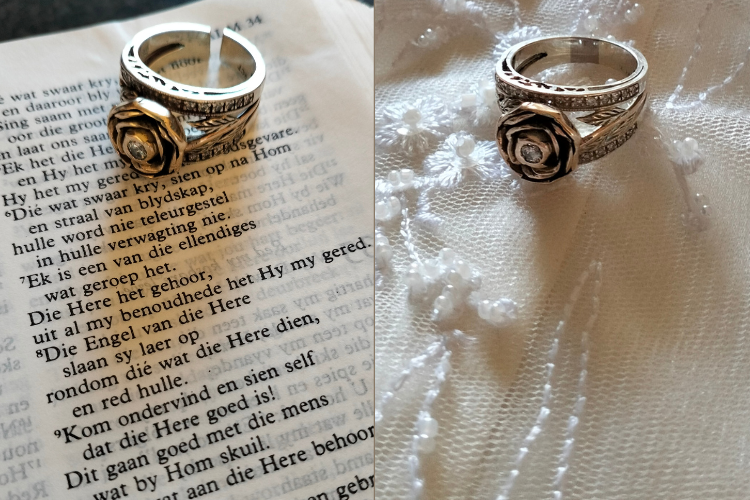
If you look at the image of Charmaine’s ring, you’ll see it’s a rose with a diamond at its centre. The petals symbolise how each member of Christ’s body comes together, in unity, as a community that glorifies Jesus—represented by the diamond at the centre (Joh 17:21–23; Rom 15:5–6).
We don’t only have a covenant with Jesus (the ring); we also have a covenant with one another in Him, as members of one body (Rom 12:5). So, we may be disappointed in Him through false expectations. Or another member may break our trust. Either way, a severing mistrust can take root in our hearts, causing real pain. (See my earlier poston the spirit of Achan, Joshua 7, for one application of this principle.)
Finding Healing and Overcoming Identity Attacks
All of us in the body of Christ carry identity wounds from childhood, and from our lives before Jesus. We will also inevitably be disappointed, and disappoint others, as we grow in Christ and look to Him for healing and restoration.
Our first priority should be to look at ourselves before we ever try to help others. God will bring people across our path who will trigger our wounds—in the world, among loved ones, among fellow believers. He does this so that we can become aware of our wounds and seek healing.
For us to become the pure seed God can multiply, and to step into a healthy expression of our calling, we need to deal with our wounds.
As Charmaine and I were praying, I saw a space open up in the Spirit. It was a place in Christ in the heavenly places. (This was in the context of what I spoke of in my previous post.) I sensed the Father say, “Come up, and step into the place of dignity.”
I sensed that in this place, our Father wants to clothe us with a cloak of dignity, to heal and insulate our hearts from the shame and false identities the enemy wants to establish in us.
Below are the first of seven areas in which we need to find healing, and grow in maturity.
1. Overcoming The Stain and Residue of Shame
From when you were a child, Satan was looking for opportunities to wound you with shame and reinforce a shame-based identity within you. Through sin, embarrassment, failure, weakness, poverty, struggle, and abuse, he wants to embed the lie: “I’m not good enough, and I’m shameful.”
Healthy, God-given shame, when you’ve done something wrong, says, “I’m ashamed of my actions.” It calls for repentance, and for asking forgiveness. But toxic shame has a horrible way of leaving a mark. It sticks to us.
In our human attempt to get rid of this awful feeling, we suppress shame and look for ways to cover it up. Satan tempts us to reach for an “I’m impressive, and I’m worthy of attention” identity, built on our own abilities.
When we give in, we find our identity in our ability to wow people with our knowledge, our insight, and our experiences. Or in our ability to be funny, dramatic, or entertaining. Or, in a more subtle way, in our ability to be respectable—with our conduct, our income, our house, our car, our reputation.
But these identities carry the residue of shame all over them. We run from the shame that lurks deep down by trying to prove—to ourselves and to others—that we are impressive, or at least respectable.
The Table of Inadequacy and Idolatry
The enemy sets a table—the table of inadequacy and idolatry—for those who’ve accepted the ashamed-impressive identity. He invites them to come and feast.
At this table, the sense of inadequacy drives people to chase impressiveness—the idol of this table. Those who achieve it are idolised, and those who don’t are often subtly marginalised. To have value at this table, you have to keep proving yourself, as idolatry grows in the hearts of everyone seated there.
The idol of self-focused impressiveness can only excite the soul—our natural faculties: the mind, will, and emotions. It’s the mental enjoyment we get from solving a difficult problem, or hearing a clever joke. It’s the willpower and “inner strength” we muster up to keep going even when things are difficult. It’s the emotional high we get from listening to a motivational speaker, or to music designed to invoke a certain mood.
Many believers mistake these things for spirituality. But the soul can never offer us an intimate connection with the presence and heart of God.
When we engage in self-focused impressiveness, we become idolaters—glorifying the creature and the created thing rather than worshipping our Creator. Or we slide into feelings of inadequacy, fixated on what we don’t have.
The Father Wants to Restore Your Dignity
Our Father is calling you to step away from this table of idolatry. He wants to heal your shame and dissolve the false impressive identity.
He wants you to know—experientially, deep down at the core of your being—that you are loved:
- That in Christ, you are forgiven and fully washed from unrighteousness, when you confess your sin.
- That your failures do not define you in Christ, but His victory does.
- That in Him you are no longer a victim, but more than a conqueror through Him who loved you.
- That in Him the weak are strong, and the poor are rich.
- That in heaven, faith—even the kind that costs you everything this world has to offer—gets celebrated, not earthly and natural respectability.
- That He knows you, as you are fearfully and wonderfully made by Him.
- That when you simply let yourself be who you truly are, in His love, you are deeply appreciated—by Him, and by all He has given eyes to see.
Our Father is inviting you to come up higher, to receive from His hands the cloak of dignity that says “I’m known; I’m appreciated.”
You Are Invited to the Table of Intimate Adoration, Intercession, and Sensitive Edification
Whoever wears the cloak of dignity—the robe of righteousness, a free gift from Jesus by His blood—is invited to the table of intimate adoration, intercession, and sensitive edification.
At this table we are fixated and in awe of our King. We pray for others to encounter Him, and we stay sensitive for opportunities to facilitate encounters with His presence and heart.
Here, we don’t care about what we know, how smart or strong or motivated we are, or how “together” our lives look. Rather than jumping from topic to topic, impressing others with what we know or what we can do, we would much rather explore one aspect of His glorious goodness in deep intimacy. Until we’re left in awe, filled with His goodness.
You are called to invite others to this table, and called to live a “living letter” lifestyle (2 Cor 3:2–3) that draws them in—with your words, actions, and attitudes.
Becoming Representatives of Dignity
We can only reproduce after the kind of the one at whose table we’re feasting. You cannot give what you don’t have, and you cannot impart what you haven’t received.
Our Father sets a table for us in the presence of our enemies (Psa 23:5)—inadequacy and idolatry. He does this so that we might overcome them, and take their spoils: the people they’ve enslaved.
Every test and trial of dignity is allowed and designed by our Father. It’s an opportunity to learn where you still need to overcome. And it’s an opportunity to sow the seed of dignity into others.
When the enemy sends signals of inadequacy, or attacks you with shame, receive the cloak of dignity for your healing. Let it become your defence. Rejoice in dignity’s identity: “I’m known; I’m appreciated.”
When the lure of idolatry knocks at your door, respond with dignity’s attitude: “I’m captivated by One; I’m sensitivein Him.”
When others are struggling to let go of the ashamed-impressive identity, see them, through the blood of Jesus, for who they were made to be. Express appreciation for their God-given design, and encourage them to align who they are with their Designer.
When believers get caught up in idolatry, invite them to set those things aside for the moment. Spend time with them instead, exploring one aspect of God’s nature in deep adoration. Invite them to become sensitive to what God’s presence wants to reveal about Himself—relevant to the lives and needs of the people in front of them.
Invite those who build their lives on soulish respectability, and who judge others who haven’t achieved what they have, to consider instead how God might want to use them: to pray for others, and to love them.
Subscribe for part 2.